

Sale and leaseback as a source of financing
Sale and leasebacks are viewed by some as a real estate exercise, evaluated in isolation from the rest of the capital stack. This view fails to realise the potential of sale and leaseback as a source of financing for the wider business. Its characteristics and cost ensure the tool can be a competitive source of financing and should be considered alongside traditional financing tools.
Sale and leaseback vs. corporate financing (corporate bonds and private debt)
The cost of financing has increased significantly since 2021 through a combination of rising risk-free rates and widening credit spreads. Whilst the real estate market has been impacted, property yields have moved less than the cost of traditional financing methods. The result is that sale and leasebacks have become an increasingly competitive source of financing.
The graph below demonstrates the window of opportunity for companies to utilise sale and leaseback whilst the spread between bond yields and real estate yields is at a historic low.
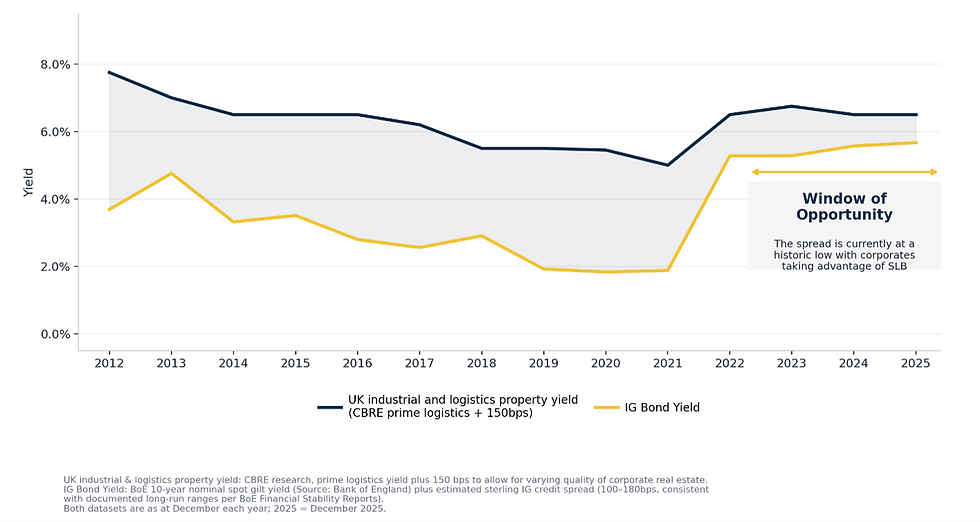
The actual yield for each property will vary (we have assumed 150bps premium on the UK Prime Logistics Yield for the graph above) but the trend is clear. Many corporates are exploring sale and leaseback whilst the spread between these two financing options is at a historic low.
A similar position is shown when compared against private debt. However, given the range of debt tranches and associated costs, sale and leaseback can often provide a cheaper form of financing:

The above graph reflects a weighted average blended margin and sale and leaseback competitiveness will depend on the type of financing being raised. However, PE Sponsors seeking to fund acquisitions through higher-leverage tranches - unitranche, second lien or HoldCo PIK - are financing at the upper end of this range, making a sale and leaseback worth evaluating as part of the capital stack.
Sale and leaseback vs. real estate finance
The more natural comparison for many is not corporate debt but a mortgage secured against the same asset. The delta in proceeds achievable via these two methods can be material. Mortgage proceeds are capped at a loan-to-value ratio against the property’s value, typically in the region of 50–65%. This property value is based on vacant possession. A sale and leaseback includes a long-term income stream which drives a higher level of proceeds. In addition, a sale and leaseback allows 100% of the value to be unlocked rather than being based on a loan to value approach.
Additional benefits: term, covenants and stability
Beyond pricing and proceeds, sale and leasebacks also offer structural advantages. Lease terms are typically 15 years plus and provide a long-dated financing option. Capcore interviewed PizzaExpress CFO, Colin Elliot, who had the following to say on this topic:
‘… think also about your overall capital structure; it's not always just about cost - a tiered structure using different types of capital with a range of maturities can mitigate the burden and risk of frequent refinancing.’
Most sale and leasebacks include rental indexation linked to inflation allowing for a more predictable ongoing cost throughout the lease. Terms are also typically covenant-lite, limited to lease obligations such as rent payment, repair and insurance, rather than the financial maintenance covenants attached to most debt facilities.
Where the opportunity is strongest
The opportunity is most compelling for SMEs and non-rated companies, which typically have fewer financing options available to them. Bond markets are largely closed to businesses below a certain scale and rating, and bank debt is priced and sized against leverage covenants that can constrain proceeds well below what the real estate itself might support. Where a business owns material real estate, sale and leaseback can open a financing route that debt and bond markets are not able to support.
For larger corporates with existing ratings the opportunity still exists to diversify its capital stack, introduce a longer-term form of financing, unlock capital already on its balance sheet and, subject to where existing financing is priced, it can still prove to be competitive on a cost basis.
The final word
Sale and leaseback deserves a place in any conversation around financing the business. Its structure provides unique benefits and subject to the alternatives, it can provide a highly competitive source of finance.


