How does a Sale and Leaseback compare to Secured Lending or Equity?
Updated: Oct 13
Sale and leaseback, secured lending, and equity all raise capital for a business — but they trade off very differently. Here's a high level overview on how to compare them.
A business needing capital usually has three broad routes: borrow against an asset it owns, sell a share of the business, or sell the asset itself and lease it back. Each converts something different into cash, and each asks the business to give up something different in return.
In our experience, businesses often default to whichever route they know best - usually the bank - without comparing what each actually costs in control, flexibility, or ownership.
The right answer depends on what the business is optimising for: maximum proceeds, retained ownership, avoiding dilution, or keeping the balance sheet clean.
Sale and leaseback compared to Secured lending
The principal difference is the proceeds that can be raised: a secured loan is capped at a loan-to-value ratio against the asset (typically 50-60% of the Vacant Possession Value), while a sale and leaseback sells the asset outright. The sale and leaseback value is typically higher than the Vacant Possession value so proceeds that are raised via this method are usually x2 or higher.

Terms differ too: lending typically brings covenants, amortisation, and a refinancing event at maturity (typically after 3 or 5 years). A lease brings none of those but it does bring a rent obligation that runs for the full term (usually 15+ years).
The trade off is that a loan leaves the business owning the asset once repaid. A sale and leaseback gives up ownership permanently in exchange for higher proceeds and lighter ongoing terms.
Sale and leaseback compared to Equity
Equity never has to be repaid or serviced but existing shareholders give up a share of the business and often some control with it. Whilst it is a forgiving form of capital - requiring no servicing or repayment - the dilutive nature tends to make it most used by those with few other options to raise capital.
Sale and leaseback proceeds are non-dilutive as no shares are issued and no board seats conceded. The business takes on a fixed rent obligation that behaves like an ongoing cost rather than a one-off capital event.
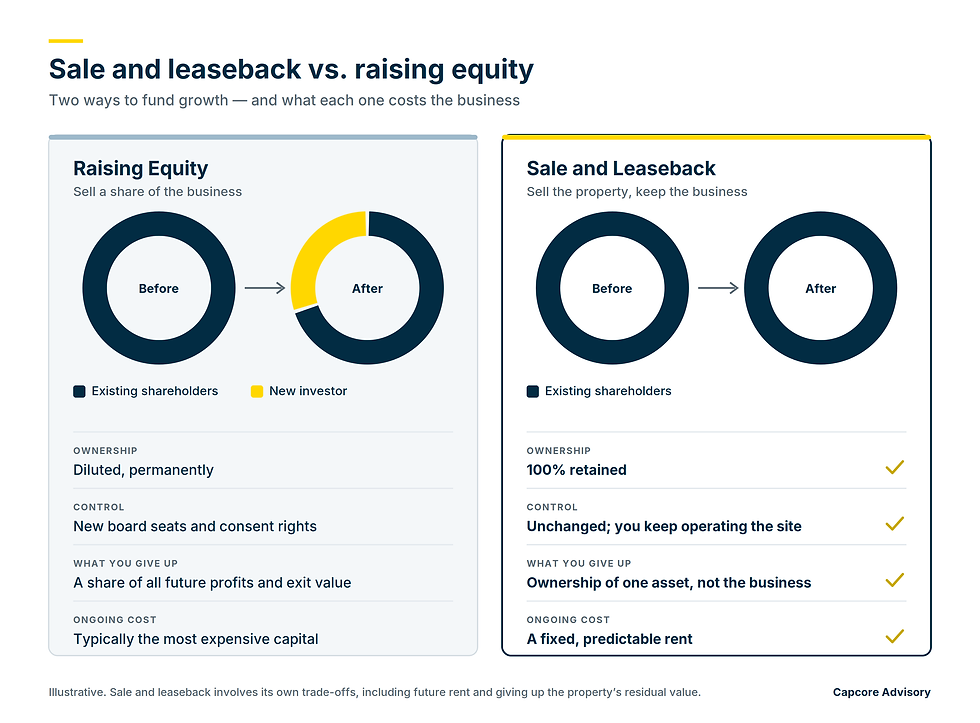
Equity usually funds growth where the payoff is uncertain whereas a sale and leaseback monetises a specific asset whose value is already know. For early stage businesses, the lack of assets means that Equity is usually the only means of growth and can actually bring associated skill sets from investors to the business to supercharge growth. For more established businesses, looking at how to best leverage their asset base is seen as more favourable.
How do I compare them?
All three of these methods have pros and cons and there is no specific path that is the ‘right choice’. Consideration needs to be given to: what assets you have and what is their useful life. Can I commit to this property for a long term (15+ years) or how do I maximise the capital raised?

What this means for a business
Prioritising maximum proceeds and no dilution, and comfortable giving up ownership? Sale and leaseback is worth investigating.
Want to keep the asset and avoid giving up equity? Secured lending, within an LTV the lender will support.
Funding growth with an uncertain payoff rather than monetising a known asset? Equity is usually the better fit.
The three routes aren't competing answers to the same question – one business could utilise all three to suit different situations. Understanding all of the options is the best way to make the right decision for your business.