
A comparison of different types of property value: Book Value, Vacant Possession (Dark Value), Market Value, Investment Value and Reinstatement Value
- 6 days ago
- 6 min read
Updated: 2 days ago
A building's ‘value’ depends entirely on who's asking. What it cost to build, what an insurer would pay to reinstate it, what a buyer would pay for it empty and what it is worth with a leaseback attached are all genuinely different numbers. In this post we will look at how they differ and why it is important to rely on the right figure.
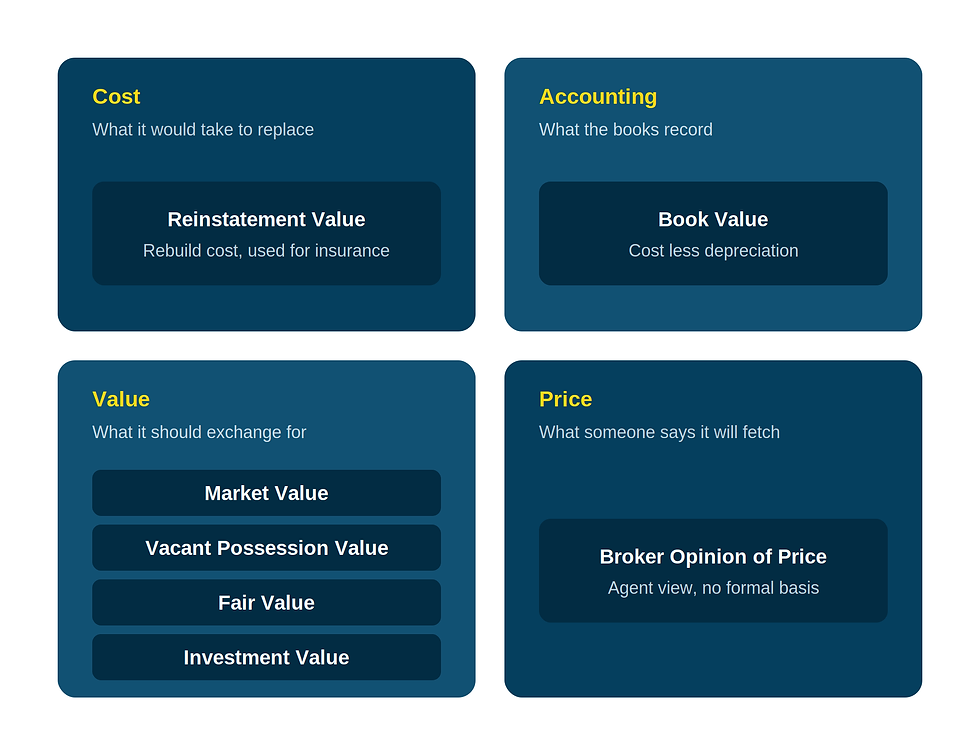
How can there be so many different valuations?
A single building will have five or six defensible figures that are deemed to be ‘valuations.’ The key thing for a business is to understand what each of them means, the basis on which it is calculated and the purpose for which it is/should be used. We often see a number of assumptions associated with valuations – understanding these will provide far more context and understanding to the figures you are looking at.
Before we start, let’s define four simple (on the face of it) concepts:
Value - the amount of money that can be received for something
Price - the amount of money for which something is sold
Worth - having a particular value, especially in money
Cost – the amount of money needed to buy, do, or make something
They all look to be variations on a theme but as we delve deeper, we will understand their nuances more. Let’s start by looking at the easiest ones to isolate:
Reinstatement Value
The title for this is a misnomer – any reinstatement figure is a cost-based assessment. If a building is insured, the number you need to know is how much it would cost to rebuild it. A common example would be the difference between what you paid for your house and the number your insurer’s model says they insure it for. This is a cost-based approach and is better termed a Reinstatement Cost Assessment.
Book Value
This is a term that is often referred to, particularly when looking at accounts. There are two ways of calculating Book Value which are quite different from each other. The simpler of the two is typically used for properties held for investment and it is ‘Mark to Market’. Effectively, a Market Value valuation (more on that later) is undertaken on a regular basis which can be monthly, quarterly or annually and the Book Value is updated accordingly tracking either up or down.
The more complex of the two and the more typically cited is an accounting concept. On a basic level, you acquire a building at a specific price, let's say £30. You then choose a period of depreciation (which for a property might be 30 or 40 years) and then reduce the value of the building by that amount each year in a linear fashion. Assuming we depreciated over 30 years then the building’s book value reduces by £1 per year. Critically, this figure is not revised in light of what is happening from a market perspective (the value could go up!) and as such should be seen as an accounting construct and not reflective of what value could be achieved if you were to sell it.
Book value is still very much key for a business in how they report a sale and the profit it generates. Issues such as how you treat land versus buildings adds more complexity.
The next figures are designed to reflect what you would receive if you sold your property on different bases.
Vacant Possession
Vacant Possession value, VP, Dark Value or Market Value on the assumption of Vacant Possession all mean the same thing. They are often used as part of an underwrite to let an owner or lender know how much they would recoup from the sale of the property if it were vacant. This ignores any leases in place, the ongoing operations that are on site and just assumes that if you marketed it empty, this is what you would receive.
Two important considerations for businesses are: how long will it take to find that buyer; and, it ignores any special purchaser. The first point is important as there is an interrelation between time and money and understanding if a sale will happen in 6 months or 36 months is crucial. The second point is also important to understand – the valuer is looking at what a sensible person in the market would pay – this is the distinction between value and worth. An adjacent land owner would likely pay a higher price and hence it is worth more to them. The challenge is that a calculation of worth is almost impossible to carry out hence we look at a broader range of buyers to arrive at value.
It is also worth noting that a building in the right location can be worth more than the business that owns and operates from it, i.e. selling it vacant may be the highest value. Understanding this distinction is particularly important for business owners looking to exit their businesses.
Fair Value
This can vary depending on jurisdiction but is generally a concept used for financial statement purposes and closely mirrors Market Value
Market Value
The widely accepted definition of market value is ‘the estimated amount an asset or liability should exchange for on the valuation date, between a willing buyer and a willing seller, in an arm's-length transaction, after proper marketing, with both parties acting knowledgeably, prudently and without compulsion.’
Market Value should give you a defensible idea of what your property is worth and can be used for a wide range of uses including loan security, tax calculations etc. A Market Valuation should be carried out by a certified valuer who holds Professional Indemnity insurance to back up what is being said. This is a regulated part of the market that is highly scrutinised given the reliance that can be put on the figures that are reported.
Market Value should reflect the existing status of the property so it could be used by a property investor who wants to understand the value of the property subject to the lease/s that are in place or by a business owner buying an empty factory and is using a secured bank loan to do so. In that second scenario Market Value and Market Value assuming Vacant Possession are the same figure.
Investment value sits in the Market Value bucket but is more commonly covered in the next section and generally looks at an owner-occupied building and at what the value would be if it were subject to a specific lease. More correctly it should be called Market Value subject to the assumption of x/y lease being in place.
Brokers Opinion of Price
The final type of ‘value’ to look at is now commonly known as - Broker Opinion of Price or BOP. This isn’t strictly a basis of value but is often used when looking at a variety of leased pricing scenarios. For example, if you were looking at undertaking a regear of an existing lease or were undertaking a sale and leaseback you may want to look at a number of scenarios. A Broker Opinion of Price is typically more forward looking as no reliance can be put on them and there is less evidential basis. It more effectively looks at what you might sell a property for subject to a stated set of assumptions. The use of price instead of value is used to distinguish the reliance that can put on these figures.
An example Broker Opinion of Price might be for a sale and leaseback looking at the potential differential in pricing between different lease terms (e.g. 15 or 25 year term) and rent escalations (e.g. linked to CPI or Market Rent) and can provide a better idea of liquidity.
What does this mean overall?
What this means is that we typically see a scale of values that looks like the following:

This is not representative of every property and scenario. Sometimes the Book Value is the highest figure and if you did a sale and leaseback at a rent of £1 per annum we could well conclude that the investment value of this asset would be low.
The final word
This article focuses on the different types of value – the methods sitting behind calculating the different values are well documented but are ultimately based on a mix of evidence and experience to which a single article won’t do justice. The key element is understanding what the basis of value is and if it is right for your purpose.